
Sarjapur Road Real Estate in 2026: A Complete Guide to New Launches & Prices
Sarjapur Road has quietly become one of the most competitive residential corridors in Bangalore. What used to be a stretch known mainly for its traffic is now home to some of the city’s biggest employment clusters — Wipro, RGA Tech Park, Embassy Tech Village, Cessna Business Park — and the housing supply has scaled up to match that demand. If you’re shortlisting a home here in 2026, you’re not short on options. The harder part is knowing which project actually fits your budget, timeline, and lifestyle.
This guide breaks down what’s driving the corridor right now, what to expect on pricing, and which upcoming projects deserve a serious look.
Table of Contents
Why Sarjapur Road Keeps Attracting Buyers
Three things are doing the heavy lifting here:
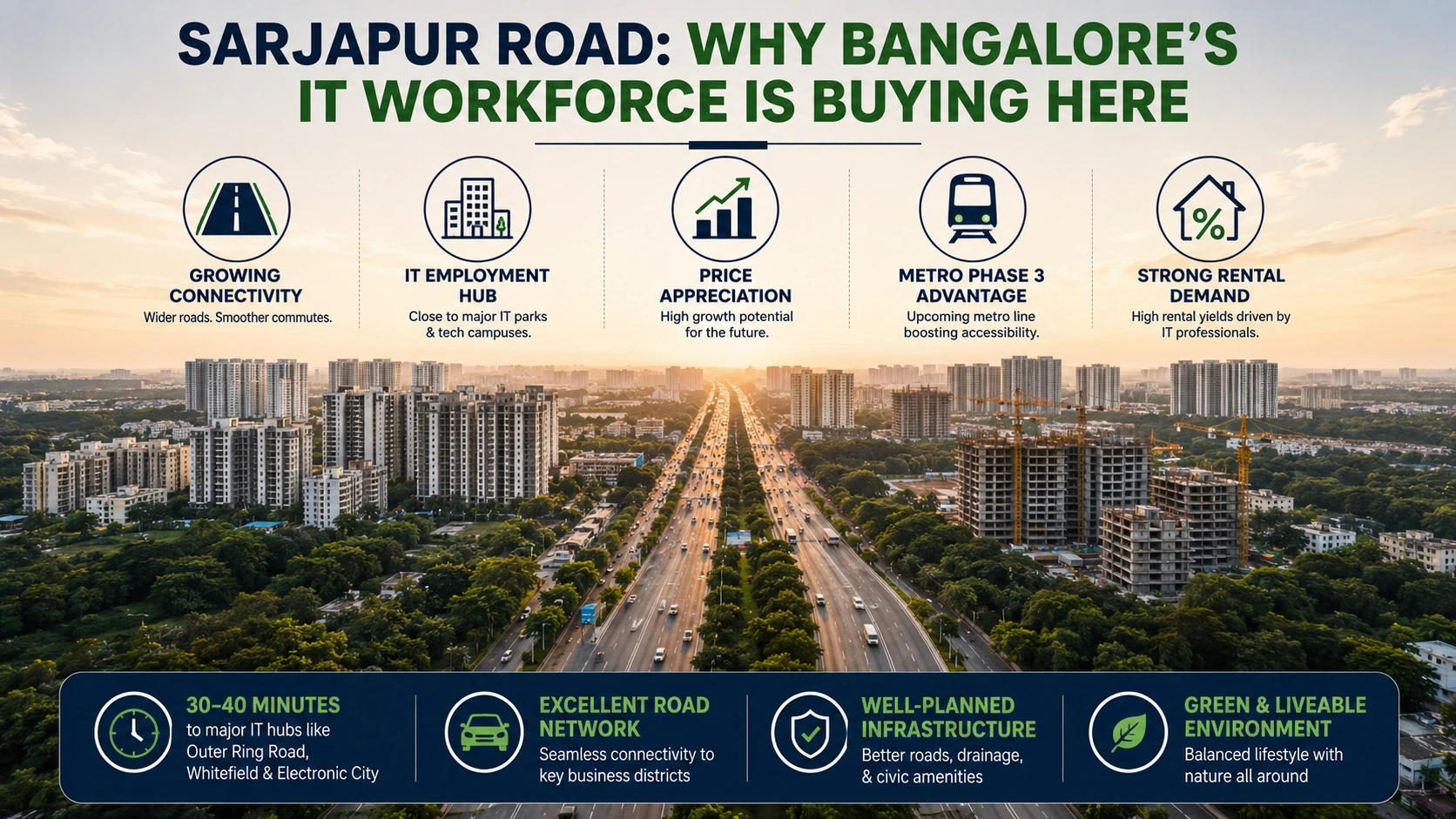
Employment density. The stretch from Gunjur to Kodathi to Bellandur sits inside a ring of IT campuses that collectively employ hundreds of thousands of people. For a lot of buyers, this isn’t an investment decision — it’s a “I don’t want to spend two hours a day commuting” decision.
Infrastructure catching up. The Outer Ring Road, the Sarjapur-Marathahalli stretch, and the proposed Namma Metro Phase 3 corridor (Sarjapur to Hebbal) are gradually solving the connectivity problems that made this area frustrating a few years ago. Metro approval alone has historically pushed prices up 15-25% in other Bangalore corridors within two years of confirmation.
Price appreciation that’s already happened — and more expected. Depending on the micro-market, Sarjapur Road has seen anywhere from 80% to over 110% price growth in the last four to five years, according to multiple market reports referencing 99acres and Propequity transaction data. That kind of run-up naturally pulls in both end-users and investors trying to catch the next leg up.
What's Changed in the Buyer Profile
A few years ago, most new supply on this corridor was 2 and 3 BHK compact apartments aimed at young IT professionals. That’s shifting. Several recent launches are skewing toward larger 3 and 4 BHK formats — a sign that developers are now building for families who’ve outgrown their first apartment and want to stay in the same corridor rather than move away from work.
This matters when you’re comparing projects: don’t just look at price per square foot, look at whether the unit mix actually matches what you need five years from now, not just today.
Projects Worth Shortlisting on Sarjapur Road Right Now
Here’s a quick look at some of the more notable projects currently in pre-launch or active construction along the corridor:
Abhee Silicon Shine & Silicon Shine Phase 2 — Compact 2 and 3 BHK options directly on Sarjapur Road, aimed at buyers who want a lower entry ticket without moving away from the main corridor. Strong fit for first-time buyers and young professionals working nearby.
Abhee Aaria, Gunjur — who are looking for peace and solitude in their residential project but at the same time don’t want to stray too far from the developed areas in East Bangalore.
In contrast to places that have their focus more on the high street experience this place could provide a more serene residential experience for its residents. On the other hand, people could also judge the location by its proximity to nearby institutions like schools and workplaces.
While comparing various residential projects available in and around Gunjur, people looking for more quietness could consider this project.
Abhee Celestial City, Gunjur — Larger-format apartments with a full amenity stack, positioned for buyers who want resort-style common areas as part of the package.
The right choice really comes down to trade-offs: ticket size vs. unit size, proximity to a specific employer vs. a quieter setting, and a larger township feel vs. a more intimate community.
Buyers comparing larger residential developments on Sarjapur Road can also explore Nambiar District 25, particularly for its township-scale planning, larger open spaces, and range of apartment configurations.
Myhna Vistara, Gunjur — A larger-scale option in the Gunjur micro-market, this RERA-approved 14-acre township sits on the newly operational 150-ft CDP Road, offering 3 and 4 BHK homes from 1,670 to 2,485 sq. ft…
Buyers also comparing newer residential developments in the Sarjapur Road–East Bangalore corridor can explore Abhee City Urban Glenn, with its apartment configurations, planned amenities, and emerging residential location.
What to Actually Check Before You Book Anywhere on This Corridor
Regardless of which project you’re leaning toward, a few things are worth verifying every single time:
- RERA status. Pre-launch EOIs are not the same as a RERA-registered booking. Get the registration number, or get written refund terms if you’re paying an EOI before registration comes through.
- Real commute time, not brochure distance. “15 minutes to Koramangala” and “20 minutes to Whitefield” are best-case, off-peak numbers. Drive the route yourself between 8-10 AM on a weekday before deciding.
- All-in cost, not base price. GST, stamp duty, registration, parking, and corpus fund typically add 18-22% on top of the quoted base price. Budget for that upfront so there’s no surprise at signing.
- Developer track record. Prefer developers with delivered projects you can actually visit. Walk a completed community on a weekday evening, talk to residents, and look at how the common areas have aged — it tells you more than any brochure.
- Open space and density. Two projects with the same unit sizes can feel completely different to live in depending on how much of the land is actually open versus built up. Ask for the exact open-space percentage, not just “landscaped gardens.”
The Bottom Line
Buyers exploring residential options around Gunjur and Sarjapur Road can also compare Abhee Celestial City, Abhee Celestial City Phase 2, and Abhee codename new dimension based on location, apartment configurations, amenities, and overall lifestyle needs. Comparing these projects can help buyers choose a home that better matches their budget and priorities.
Frequently Asked Questions
Yes, based on current market data. The corridor has seen strong price appreciation over the past four to five years, driven by genuine IT employment demand rather than speculative buying alone. The proposed Namma Metro Phase 3 connecting Sarjapur to Hebbal adds a further upside trigger once it receives central approval.
Projects directly on the main road offer the shortest commute to major employers like Wipro and RGA Tech Park but come with higher traffic exposure and typically higher price per square foot. Interior micro-markets like Gunjur tend to be quieter and slightly more affordable, at the cost of a longer commute to the main employment clusters.
It depends on what you value. Larger townships generally offer more extensive amenities and social infrastructure. Smaller, low-density developments — like projects with 85%+ open space on a five-to-six acre footprint — tend to offer a quieter, more intimate community feel with shorter lift waits and lower crowding in common areas. Neither is objectively better; it’s a lifestyle trade-off.
Plan for an additional 18-22% on top of the base price to cover GST, stamp duty and registration, parking charges, club/corpus fund, and advance maintenance. This applies broadly across Sarjapur Road projects, not just one specific development.
It’s common practice in pre-launch stages, but you should always get written confirmation of the refund terms in case RERA registration is delayed or the project doesn’t proceed as planned. Avoid verbal assurances — get it in writing before transferring any amount.
Current market data puts gross rental yields on well-located Sarjapur Road apartments in the 3.5% to 5% range, which is above Bangalore’s broader residential average of roughly 3%. Properties closest to major IT campuses tend to sit at the higher end of that range due to consistent demand from working professionals.
Check whether the developer is listed on the stock exchange (which means audited financials are publicly available), how many projects they’ve actually delivered versus how many are still under construction, and — most importantly — visit a completed project in person. Talk to current residents about maintenance quality and how the building has held up over time.